<?xml version="1.0" encoding="utf-8"?><feed xmlns="http://www.w3.org/2005/Atom" ><generator uri="https://jekyllrb.com/" version="4.4.1">Jekyll</generator><link href="https://oilslickcoffee.com/atom.xml" rel="self" type="application/atom+xml" /><link href="https://oilslickcoffee.com/" rel="alternate" type="text/html" /><updated>2026-03-13T17:51:27+00:00</updated><id>https://oilslickcoffee.com/atom.xml</id><title type="html">Oil Slick Coffee</title><subtitle>Making sense of the coffee world</subtitle><entry><title type="html">Short-to-medium-term coffee prices</title><link href="https://oilslickcoffee.com/short-to-medium-term-coffee-prices/" rel="alternate" type="text/html" title="Short-to-medium-term coffee prices" /><published>2026-03-13T09:31:00+00:00</published><updated>2026-03-13T09:31:00+00:00</updated><id>https://oilslickcoffee.com/short-to-medium-term-coffee-prices</id><content type="html" xml:base="https://oilslickcoffee.com/short-to-medium-term-coffee-prices/"><![CDATA[<p>The US–Israel–Iran war is expected to affect coffee shipping and exports worldwide, and therefore global coffee prices. Exactly what the impact will be is uncertain. The risk is not limited to shipping disruptions. Coffee production is energy-intensive, relying on fuel for transportation, electricity for processing, and especially synthetic fertilizers whose production depends heavily on energy.</p>

<p>I recently bought a significant amount of coffee after prices pulled back from earlier highs during the tariff drama. The C-market price for commodity coffee—which serves as the benchmark for most coffee pricing—has not risen dramatically since the conflict began. Over the past twelve months the market reached a high of $4.13 per pound on November 16. It is currently about $2.85 per pound, and the highest price since the conflict began was $3.01 per pound on March 8. These figures reflect commodity-grade coffee; specialty coffee typically trades at a premium above the C-market.</p>

<p>For now, coffee prices at Oil Slick Coffee are expected to remain stable for at least the next four weeks. At the current consumption rate, I have more than two months of supply across all coffees. Because of that, I am attempting to wait out the situation rather than raise prices in anticipation of higher replacement costs.</p>

<p>I am also looking for one or two new coffees to add to the lineup, but I plan to be conservative. With adequate inventory on hand, there is no need to pay a market risk premium at this time.</p>

<p>My goal remains the same: to provide approachable, affordable, quality coffee.</p>]]></content><author><name>Michael C. Wright</name><email>MichaelTrains@OilSlickCoffee.com</email></author><summary type="html"><![CDATA[For now, coffee prices at Oil Slick Coffee are expected to remain stable for at least the next four weeks. At the current consumption rate, I have more than two months of supply across all coffees.]]></summary><media:thumbnail xmlns:media="http://search.yahoo.com/mrss/" url="https://oilslickcoffee.com/%7B%22feature%22%20=%3E%20nil,%20%22teaser%22%20=%3E%20%22coffee-markets-th.jpeg%22,%20%22thumb%22%20=%3E%20nil%7D" /><media:content medium="image" url="https://oilslickcoffee.com/%7B%22feature%22%20=%3E%20nil,%20%22teaser%22%20=%3E%20%22coffee-markets-th.jpeg%22,%20%22thumb%22%20=%3E%20nil%7D" xmlns:media="http://search.yahoo.com/mrss/" /></entry><entry><title type="html">Experimental Fermentation in Specialty Coffee</title><link href="https://oilslickcoffee.com/economics/experimental-fermentation-in-specialty-coffee/" rel="alternate" type="text/html" title="Experimental Fermentation in Specialty Coffee" /><published>2024-05-09T07:09:00+00:00</published><updated>2024-05-09T07:09:00+00:00</updated><id>https://oilslickcoffee.com/economics/experimental-fermentation-in-specialty-coffee</id><content type="html" xml:base="https://oilslickcoffee.com/economics/experimental-fermentation-in-specialty-coffee/"><![CDATA[<p><em>This article was adapted from a <a href="https://x.com/OilSlickCoffee/status/1788225035884482847" rel="noopener noreferrer external">thread on X</a>, which was in response to the article titled “<a href="https://perfectdailygrind.com/2024/05/funky-coffee-flavour-profiles/" rel="noopener noreferrer external">Have coffee flavour profiles become too “funky”?</a>” by Thomas Wensma.</em></p>

<p>In specialty coffee, the surge of experimental fermentation processes has sparked both fascination and controversy. Coffee enthusiasts are increasingly encountering flavors in their cups that might be more at home in a jar of kimchi or a bottle of kombucha than in a coffee pot. How does this shift impact the identity of a given coffee, particularly when it comes to beans that claim a specific geographical origin?</p>

<h2 id="traditional-vs-experimental-whats-in-a-flavor">Traditional vs. Experimental: What’s in a Flavor?</h2>

<p>Costa Rica has a strong tradition of coffee production and coffee consumption. A large portion of the coffee produced by Costa Rica is consumed by Costa Ricans—a rare thing for most producing countries. The coffee industry there is also highly regulated by the government. For example, coffee growers are required to grow only arabica coffee as opposed to robusta, which is generally of lower quality flavor (this is slowly changing with improved processing of robusta).</p>

<p>This strong coffee culture results in disciplined coffee production and processing, which in-turn produces a clean and predictable flavor profile. This predictable profile is so integral that it has almost become a hallmark of Costa Rican coffee. However, when mills in Costa Rica—or anywhere else—begin using experimental fermentation methods or commercial microbes that radically alter the flavor profile, it begs the question: Can these coffees still be considered true to their origins?</p>

<p>This is not just a theoretical debate but touches on the very practical aspects of how coffee is marketed and understood by consumers. If a Costa Rican coffee loses its typical flavor profile due to experimental processing, does it lose its identity—and thus its marketability—as Costa Rican coffee?</p>

<h2 id="the-role-of-tastemakers-in-coffee-innovation">The Role of Tastemakers in Coffee Innovation</h2>

<p>The push for innovation in coffee processing is essential for the industry’s growth, but it brings with it a host of challenges. Producers and processors that experiment with what are essentially new products must understand and accept the risk involved with not finding a market for the new product. Processors (mills) that are already struggling to market and sell industry-accepted coffees such as washed-process or natural-process, will likely find it even more difficult to market experimentals. But tastemakers can help.</p>

<p>Tastemakers in the industry play a crucial role in steering consumer preferences. Tastemakers include the well-established, specialty coffee companies that have the ability to bring to market radically new coffees and introduce them to an established customer-base that is receptive to new things. But there is risk involved, even for tastemakers. They need to find a flavor profile that is acceptable to a broad enough customer-base that it is economically viable. If the flavor profile is too radical, customers may not buy it repeatedly. If the coffee is too difficult to describe and market, customers may not try it at all. In both cases, the market essentially does not recognize the quality of the product as the tastemakers do.</p>

<p>As experimentation  becomes more common, the industry must navigate these changes carefully to ensure that innovation does not compromise the inherent qualities of the coffee.</p>

<p><strong>See also: <a href="/economics/market/in-defense-of-tastemakers/?utm_source=Experimental-Fermentation-in-Specialty-Coffee&amp;utm_medium=blog&amp;utm_content=/economics/market/in-defense-of-tastemakers/&amp;utm_campaign=see-also">In Defense of Tastemakers</a></strong></p>

<h2 id="balancing-innovation-with-tradition">Balancing Innovation with Tradition</h2>

<p>The debate over experimental fermentation in coffee also highlights the risks involved, particularly for smallholders. As quoted in a recent article on Perfect Daily Grind, Ildi Revi of Purity Coffee remarks, “You can dive down a rabbit hole of flavour exceptionality, but it can be too easy to lose sight of the nuts and bolts of your business”.<a class="citation" href="#wensma-pdg-2024">(Wensma, 2024)</a> This comment underscores the need for producers to weigh the benefits of innovation against the potential costs, ensuring that any new methods enhance rather than detract from their business.</p>

<p>For coffee producers, the goal should be to maintain optionality. Experimentation needs to be manageable and should not overwhelm the basic needs of the business. In this way, innovation can proceed without jeopardizing the livelihood of the producer.</p>

<p><strong>See also: <a href="/production/producers-optionality/?utm_source=Experimental-Fermentation-in-Specialty-Coffee&amp;utm_medium=blog&amp;utm_content=https://oilslickcoffee.com/production/producers-optionality/&amp;utm_campaign=see-also">Producer’s Optionality</a></strong></p>

<h2 id="conclusion">Conclusion</h2>

<p>As the coffee industry continues to evolve, the interplay between traditional processing methods and innovative techniques will undoubtedly continue to provoke discussion and debate. For coffee lovers and producers alike, finding a balance that respects the heritage of the coffee while embracing the possibilities of innovation will be key to the future of coffee.</p>

<p>This exploration into the changing flavor profiles in coffee due to experimental fermentation processes shows just how dynamic the coffee industry can be. As we venture into these new tasting territories, the community must remain thoughtful about preserving the integrity and heritage of traditional coffee flavors while embracing the new and unusual.</p>

<ol class="bibliography"><li><span id="wensma-pdg-2024">Wensma, T. (2024). <i>Have coffee flavour profiles become too “funky”?</i> https://perfectdailygrind.com/2024/05/funky-coffee-flavour-profiles/</span></li></ol>]]></content><author><name>Michael C. Wright</name><email>MichaelTrains@OilSlickCoffee.com</email></author><category term="Economics" /><category term="Costa Rica" /><category term="Smallholders" /><category term="Tastemakers" /><summary type="html"><![CDATA[Producers and processors that experiment with what are essentially new products must understand and accept the risk involved with not finding a market.]]></summary><media:thumbnail xmlns:media="http://search.yahoo.com/mrss/" url="https://oilslickcoffee.com/%7B%22feature%22%20=%3E%20nil,%20%22teaser%22%20=%3E%20%22DALL%C2%B7E%202024-05-08-experimental-fermentation-th.png%22,%20%22thumb%22%20=%3E%20nil%7D" /><media:content medium="image" url="https://oilslickcoffee.com/%7B%22feature%22%20=%3E%20nil,%20%22teaser%22%20=%3E%20%22DALL%C2%B7E%202024-05-08-experimental-fermentation-th.png%22,%20%22thumb%22%20=%3E%20nil%7D" xmlns:media="http://search.yahoo.com/mrss/" /></entry><entry><title type="html">The EU Deforestation Regulation and Its Impact on Smallholder Coffee Farmers</title><link href="https://oilslickcoffee.com/sustainability/the-eu-deforestation-regulation-and-its-impact-on-smallholder-coffee-farmers/" rel="alternate" type="text/html" title="The EU Deforestation Regulation and Its Impact on Smallholder Coffee Farmers" /><published>2024-03-25T07:32:00+00:00</published><updated>2024-03-25T07:32:00+00:00</updated><id>https://oilslickcoffee.com/sustainability/the-eu-deforestation-regulation-and-its-impact-on-smallholder-coffee-farmers</id><content type="html" xml:base="https://oilslickcoffee.com/sustainability/the-eu-deforestation-regulation-and-its-impact-on-smallholder-coffee-farmers/"><![CDATA[<p>The European Union has taken a big step in its environmental and sustainability efforts with the introduction of the European Union Deforestation Regulation (EUDR). This landmark regulation aims to combat global deforestation and forest degradation by controlling the import and export of certain commodities, including coffee, that are linked to deforestation. As noble as its intentions are, the EUDR presents a complex challenge, especially for smallholder coffee farmers who play a crucial role in the coffee supply chain. Let’s delve into what the EUDR entails and explore its potential impacts on these vital contributors to the coffee industry.</p>

<h2 id="understanding-the-eudr">Understanding the EUDR</h2>

<p>The EUDR, effective from June 29, 2023, mandates that commodities entering the EU market must not contribute to deforestation or forest degradation post-December 31, 2020. This includes a range of products from cattle, wood, cocoa, soy, palm oil, coffee, to rubber, and their derivatives. The regulation is a response to the EU’s commitment to reducing its environmental footprint and promoting sustainable consumption patterns.</p>

<p><a class="citation" href="#Ghosal-eudr-2024">(Ghosal, 2024)</a></p>
<h3 id="key-provisions-of-the-eudr">Key Provisions of the EUDR</h3>

<ul>
  <li><strong>Deforestation-Free Requirement</strong>: Products must be certified as not contributing to deforestation or forest degradation.</li>
  <li><strong>Due Diligence Obligations</strong>: Companies are required to conduct risk assessments and ensure traceability throughout their supply chains, proving their products comply with the EUDR.</li>
  <li><strong>Enforcement and Penalties</strong>: Non-compliance could result in significant penalties, including fines and restrictions on market access.</li>
</ul>

<p><a class="citation" href="#kpmg-eudr-2023">(Wagemans, 2023)</a></p>

<h2 id="the-ripple-effect-on-smallholder-coffee-farmers">The Ripple Effect on Smallholder Coffee Farmers</h2>

<p>The EUDR casts a wide net that will ensnare smallholder coffee farmers, many of whom are already navigating the challenges of climate change and market fluctuations. Here’s how the regulation could impact them:</p>

<h3 id="increased-costs-and-market-access-hurdles">Increased Costs and Market-Access Hurdles</h3>

<p>Compliance with the EUDR means added costs for certification and potentially for adopting new farming practices. Smallholders, with their limited resources, may find these costs prohibitive, threatening their access to the EU market.</p>

<h3 id="technological-and-financial-gaps">Technological and Financial Gaps</h3>

<p>The requirement for detailed traceability and risk assessments could widen the technological and financial divide between smallholders and larger agricultural entities. Without access to necessary technologies or the capital to invest in them, smallholders might struggle to meet the EUDR’s stringent requirements. Consider the difference in how smallholders in general leverage the Internet. It is still not uncommon for smallholder farmers’ only access to the Internet to be through a smartphone.</p>

<center><blockquote class="twitter-tweet"><p lang="en" dir="ltr">Why <a href="https://twitter.com/hashtag/blockchain?src=hash&amp;ref_src=twsrc%5Etfw">#blockchain</a> is a non-starter for Indonesian <a href="https://twitter.com/hashtag/farmers?src=hash&amp;ref_src=twsrc%5Etfw">#farmers</a>: &#39;...85-90% of farmers have good access to the Internet and use the popular messaging channel WhatsApp, but only 2% go online to buy or sell goods and only about 30% are willing to consider this.&#39; <a href="https://t.co/UtIcucTaab">https://t.co/UtIcucTaab</a></p>&mdash; Michael Wright (@OilSlickCoffee) <a href="https://twitter.com/OilSlickCoffee/status/1390205406354415616?ref_src=twsrc%5Etfw">May 6, 2021</a></blockquote> <script async="" src="https://platform.twitter.com/widgets.js" charset="utf-8"></script></center>

<h3 id="marginalization-and-the-path-forward">Marginalization and the Path Forward</h3>

<p>There’s a real risk that the EUDR could marginalize smallholder coffee farmers, favoring larger, industrial operations that can more easily absorb compliance costs. By tapping into certification programs, leveraging collective action through cooperatives, and engaging with NGOs and government bodies for support, smallholders can navigate these new waters.</p>

<h2 id="advocating-for-smallholder-friendly-policies">Advocating for Smallholder-Friendly Policies</h2>

<p>The implementation of the EUDR underscores the need for policies that consider the unique challenges faced by smallholder farmers. Advocacy for simplified compliance procedures, financial and technical assistance, and increased support for sustainable farming practices is crucial. Moreover, diversifying markets can serve as a buffer, reducing smallholders’ dependency on the EU market. Transitioning already-struggling coffee farmers out of coffee should also be considered.</p>

<p><strong>See also: <a href="/economics/market/transitioning-coffee-farmers-out-of-coffee/?utm_source=The-EU-Deforestation-Regulation-and-Its-Impact-on-Smallholder-Coffee-Farmers&amp;utm_medium=blog&amp;utm_content=/economics/market/transitioning-coffee-farmers-out-of-coffee/&amp;utm_campaign=see-also">Transitioning Coffee Farmers Out of Coffee</a></strong></p>

<h2 id="navigating-compliance-support-for-smallholder-farmers">Navigating Compliance: Support for Smallholder Farmers</h2>

<p>Several organizations have stepped up to offer (read; <em>sell</em>) support for smallholders navigating the EUDR. For example; Rainforest Alliance, Fairtrade International, and Satelligence are offering tools, partnerships, and initiatives designed to bridge the gap between smallholders and compliance with the EUDR.</p>

<ul>
  <li>Rainforest Alliance is offering AI-led remote sensing <a class="citation" href="#rainforest-alliance-eudr-2024">(<i>Rainforest Alliance Supports Companies to Make a Big Leap Towards EUDR Compliance</i>, 2024)</a></li>
  <li>Fairtrade International partnered with Satelligence to provide imagery and monitoring services <a class="citation" href="#myers-eudr-2024">(Myers, 2023)</a></li>
</ul>

<h2 id="conclusion">Conclusion</h2>

<p>The EUDR represents a significant step towards addressing global deforestation, but it’s imperative that its implementation does not come at the expense of smallholder coffee farmers. As the EU and other stakeholders work towards sustainable consumption and production, support for smallholder coffee farmers must remain a priority.</p>

<ol class="bibliography"><li><span id="Ghosal-eudr-2024">Ghosal, A. (2024). <i>‘Winners and losers’: The world of coffee is being reordered by EU laws to stop cutting of forests</i>. https://apnews.com/article/vietnam-coffee-deforestation-eu-20e3fac82a42beb38013980fa7a760e6</span></li>
<li><span id="kpmg-eudr-2023">Wagemans, M. (2023). <i>A high-level introduction to the EU Deforestation-Free Regulation (EUDR)</i>. https://kpmg.com/be/en/home/insights/2023/02/sus-the-eu-anti-deforestation-regulation.html</span></li>
<li><span id="rainforest-alliance-eudr-2024"><i>Rainforest Alliance Supports Companies to Make a Big Leap Towards EUDR Compliance</i>. (2024). https://www.rainforest-alliance.org/press-releases/rainforest-alliance-supports-companies-to-make-a-big-leap-towards-eudr-compliance/</span></li>
<li><span id="myers-eudr-2024">Myers, A. (2023). <i>Fairtrade partners with Satelligence to boost cocoa producers’ deforestation monitoring</i>. https://www.confectionerynews.com/Article/2023/11/08/fairtrade-partners-with-satelligence-to-boost-cocoa-producers-deforestation-monitoring</span></li></ol>]]></content><author><name>Michael C. Wright</name><email>MichaelTrains@OilSlickCoffee.com</email></author><category term="Sustainability" /><category term="Sustainability" /><category term="Sustainable coffee production" /><category term="Smallholders" /><category term="EU Deforestation Regulation" /><category term="EUDR" /><summary type="html"><![CDATA[The EUDR represents a significant step towards addressing global deforestation. It’s imperative that its implementation does not come at the expense of smallholder coffee farmers.]]></summary><media:thumbnail xmlns:media="http://search.yahoo.com/mrss/" url="https://oilslickcoffee.com/%7B%22feature%22%20=%3E%20nil,%20%22teaser%22%20=%3E%20%22DALL%C2%B7E%202024-03-25-EUDR-impact-smallholders-th.png%22,%20%22thumb%22%20=%3E%20nil%7D" /><media:content medium="image" url="https://oilslickcoffee.com/%7B%22feature%22%20=%3E%20nil,%20%22teaser%22%20=%3E%20%22DALL%C2%B7E%202024-03-25-EUDR-impact-smallholders-th.png%22,%20%22thumb%22%20=%3E%20nil%7D" xmlns:media="http://search.yahoo.com/mrss/" /></entry><entry><title type="html">Organically Grown Coffee</title><link href="https://oilslickcoffee.com/sustainability/organically-grown-coffee/" rel="alternate" type="text/html" title="Organically Grown Coffee" /><published>2024-02-17T10:05:00+00:00</published><updated>2024-02-17T10:05:00+00:00</updated><id>https://oilslickcoffee.com/sustainability/organically-grown-coffee</id><content type="html" xml:base="https://oilslickcoffee.com/sustainability/organically-grown-coffee/"><![CDATA[<p>I’ve previously written about <a href="/sustainability/organic-coffee/">certified organic coffee</a> and its potential impact on farmers.</p>

<p>I recently purchased an un-roasted, certified organic coffee to roast and sell. However, I am not able to market it as an Organic coffee because I am unable to satisfy the US Department of Agriculture (USDA) requirements to roast the coffee in a facility certified by them.</p>

<p>In this article, I explore what that means.</p>

<center><em>(I have an audio version of this article or you can just read on)</em></center>

<script src="https://cdn.podlove.org/web-player/5.x/embed.js"></script>
<noscript>Enable javascript to see the web player.</noscript>

<div id="variant-m" data-variant="m"></div>

<script>
  window.onload = function () {
    podlovePlayer('#variant-m', '/episodes/articles-read-organically-grown-episode.json', '/episodes/articles-read-organically-grown-config.json');  }
</script>

<h2 id="usda-requirements-for-organic-coffee">USDA requirements for Organic coffee</h2>

<p>To sell coffee in the United States labeled as “organic,” a coffee roaster must comply with several requirements established by the United States Department of Agriculture (USDA) under the <a title="The Electronic Code of Federal Regulations, 7 CFR Part 205" href="https://www.ecfr.gov/current/title-7/subtitle-B/chapter-I/subchapter-M/part-205" rel="noopener noreferrer external">National Organic Program</a> (NOP). These requirements include:</p>

<ol>
  <li>
    <p><strong>Organic Certification</strong>: The coffee must be certified organic by a USDA-accredited certifying agent. This ensures that the coffee is grown and processed according to federal guidelines addressing factors such as soil quality, pest and weed control, and use of additives. (<a href="https://www.ecfr.gov/current/title-7/subtitle-B/chapter-I/subchapter-M/part-205/subpart-B/section-205.100" rel="noopener noreferrer external">7 CFR Part205, § 205.100</a>)</p>
  </li>
  <li>
    <p><strong>Sourcing of Organic Beans</strong>: The coffee beans must be grown without the use of <a title="The National List of Allowed and Prohibited Substances" href="https://www.ecfr.gov/current/title-7/subtitle-B/chapter-I/subchapter-M/part-205/subpart-G/subject-group-ECFR0ebc5d139b750cd" target="_blank">prohibited substances</a>, like certain pesticides and fertilizers, for three years before the harvest used for organic coffee. <meta charset="utf-8" />(<a href="https://www.ecfr.gov/current/title-7/subtitle-B/chapter-I/subchapter-M/part-205/subpart-E/section-205.400" target="_blank">7 CFR Part205, § 205.400</a>)</p>
  </li>
  <li>
    <p><strong>Roasting Process</strong>: The roasting facility must also be certified for handling organic products. This ensures that there is no cross-contamination forbidden products. <meta charset="utf-8" />(<a href="https://www.ecfr.gov/current/title-7/subtitle-B/chapter-I/subchapter-M/part-205/subpart-B/section-205.100" rel="noopener noreferrer external">7 CFR Part205, § 205.100</a>)</p>
  </li>
  <li>
    <p><strong>Record-Keeping</strong>: The roaster must keep detailed records that document the production, handling, and sales of the organic coffee. <meta charset="utf-8" />(<a href="https://www.ecfr.gov/current/title-7/subtitle-B/chapter-I/subchapter-M/part-205/subpart-B/section-205.103" target="_blank" rel="noopener noreferrer external">7 CFR Part205, § 205.103</a>)</p>
  </li>
  <li>
    <p><strong>Labeling</strong>: Compliance with organic labeling requirements is mandatory. This includes using the USDA organic seal and proper representation of the organic content (e.g., “100% Organic”, “Organic”, or “Made with Organic Ingredients” depending on the specific content). <meta charset="utf-8" />(<a href="https://www.ecfr.gov/current/title-7/subtitle-B/chapter-I/subchapter-M/part-205/subpart-D" target="_blank">7 CFR Part205, Subpart D</a>)</p>
  </li>
  <li>
    <p><strong>Inspection and Compliance</strong>: Regular inspections are conducted to ensure ongoing compliance with organic standards. This includes reviews of the facilities and processes, as well as testing of soil and water. <meta charset="utf-8" />(<a href="https://www.ecfr.gov/current/title-7/subtitle-B/chapter-I/subchapter-M/part-205/subpart-E/section-205.403" target="_blank">7 CFR Part205, § 205.403</a>)</p>
  </li>
  <li>
    <p><strong>Prevention of Contamination</strong>: Measures must be in place to prevent contamination of organic beans with prohibited substances or commingling with non-organic products. <meta charset="utf-8" />(<a href="https://www.ecfr.gov/current/title-7/subtitle-B/chapter-I/subchapter-M/part-205/subpart-C/section-205.272" target="_blank">7 CFR Part205, § 205.272</a>)</p>
  </li>
  <li>
    <p><strong>Marketing and Sales</strong>: When marketing organic coffee, all claims must be truthful and not misleading regarding the organic status and practices. <meta charset="utf-8" />(<a href="https://www.ecfr.gov/current/title-7/subtitle-B/chapter-I/subchapter-M/part-205/subpart-D" rel="noopener noreferrer external">7 CFR Part205, Subpart D</a>)</p>
  </li>
</ol>

<h2 id="effects-of-roasting-on-a-products-organic-integrity">Effects of roasting on a product’s organic integrity</h2>

<p>The USDA requires the <strong>prevention of contamination</strong> of organic beans with prohibited substances or commingling with non-organic products. It is generally understood that in the roastery, this means a dedicated roasting machine for organic coffee. The underlying assumption is that beans rolling around inside a roasting machine or in the cooling tray can be contaminated with forbidden substances. <a href="https://www.ecfr.gov/current/title-7/subtitle-B/chapter-I/subchapter-M/part-205/subpart-C/section-205.272" rel="noopener noreferrer external">USDA regulations forbid the following</a>:</p>

<blockquote>
  <p>The use or reuse of any bag or container that has been in contact with any substance in such a manner as to compromise the organic integrity of any organically produced product or ingredient placed in those containers, unless such reusable bag or container has been thoroughly cleaned and poses no risk of contact of the organically produced product or ingredient with the substance used.</p>
</blockquote>

<p>That generates a couple of questions:</p>

<ol>
  <li>What is considered an appropriate method of cleaning a roaster? Does a “throw-away” roast of organic coffee suffice?</li>
  <li>What forbidden products actually survive the heat of roasting and thus pose a threat?</li>
</ol>

<p>To explore the second question, I looked into arsenic, one of the forbidden substances.</p>

<h2 id="arsenic-in-coffee">Arsenic in coffee</h2>
<p>The <a href="https://www.periodic-table.org/arsenic-melting-point/" rel="noopener noreferrer external">melting point for arsenic</a> is 817°C (1,502.6°F). Its <a href="https://sciencenotes.org/volatility-volatile-definition-in-chemistry/" rel="noopener noreferrer external">volatilization</a> occurs around 300-600°C (572-1,112°F).<a class="citation" href="#Xu2022">(Xu et al., 2022)</a></p>

<p>Light-roasted beans are typically ejected from the machine at a bean temp around 177°C to 204°C (350°F to 400°F). This roast level would include the very light, Nordic-style of roasts.</p>

<p>Dark-roasted beans are typically ejected from the machine at a bean temp around 224°C to 232°C (about 435°F to 450°F) or higher. This roast level produces dark-brown to black coffee beans, often with a wet sheen of oil on the surface.</p>

<p>The environment or ambient temperatures of the roasting drum can exceed 700°C (1,292°F) by the end of even a light roast, depending on the design of the machine and the time-and-temperature profile applied by the operator.</p>

<p>Therefore the rate at which arsenic is removed from a coffee bean depends on the design of the machine and <a href="/roasting/understanding-the-roast-profile/">the roast profile</a> used. Longer and darker roasts have a better chance of removing more arsenic than shorter and lighter roasts.</p>

<p>Arsenic is classified as a class or group 1 carcinogen by the International Agency of Research on Cancer.<a class="citation" href="#Farooq2016">(Farooq et al., 2016)</a></p>

<p>It is found naturally in soils and water (fresh and salt water). Sources include volcanic emissions, rock weathering, and discharge from hot springs.<a class="citation" href="#Farooq2016">(Farooq et al., 2016)</a></p>

<p>Arsenic is also used in pesticides and fertilizers—though more-so outside the US. In the US, use of arsenic in fertilizers and pesticides is restricted and limited to organic arsenic compounds in a limited number of approved uses.(<a href="https://www.epa.gov/sites/default/files/2021-04/documents/arsenic_april_2021.pdf" rel="noopener noreferrer external">EPA: Arsenic Compounds, 2021</a>)</p>

<p>Plants take up arsenic through the soil and water, transport it throughout the plant via vascular tissue, and can store or compartmentalize it in organelles within the cells. <a class="citation" href="#Farooq2016">(Farooq et al., 2016)</a></p>

<p>Therefore, if arsenic is present in coffee beans, it is present at the cellular level and not necessarily as a coating on the outside of the seed where it could be easily removed or transferred to another surface.</p>

<p>However, when we roast coffee, we impart physical changes that include fracturing of cell walls, increasing the size of micropores, and creating microfissures within the bean. The pressure within the bean increases and begins to force liquified lipids and other compounds to the surface of the bean.<a class="citation" href="#espresso2005">(Andrea Illy, 2005)</a></p>

<p>It is possible that the fracturing, fissuring, and internal pressure inside the beans and the volatilization of arsenic that results from the roasting process releases arsenic into the machine, contaminating the surfaces.</p>

<p>But this generates more questions, such as; at what levels is arsenic released from the beans; at what rate is it then transferred from the surfaces of the machine to beans; and at what rate is arsenic transferred from roasted and ground  beans into water during the brewing/extraction phase?</p>

<h3 id="arsenic-and-iron">Arsenic and iron</h3>

<p>Something I haven’t looked deeply into; certain arsenic molecules and certain iron molecules tend to chemically bond with each other well.(<a href="https://www.ncbi.nlm.nih.gov/books/NBK230885/" rel="noopener noreferrer external">NIH: Arsenic in Drinking Water, 2009)</a> Many of the components of a roaster, especially the drum, contain iron.</p>

<blockquote><p>The affinity of arsenic (As) with iron (oxyhydr)oxides is known, at least, since 1835, when Robert Bunsen used iron hydroxides to revert As poisonings.</p><cite><a class="citation" href="#Souza2023">(Souza &amp; Ciminelli, 2023)</a></cite></blockquote>

<p>Understanding arsenic’s affinity for iron oxide and the levels and nature of iron oxides in a given roaster may help answer the question of how to clean a roaster. If arsenic is adsorbed and fixed in a roaster in this way, I doubt a “throw-away” roast alone would sufficiently clean the roaster. Souza and Ciminelli also state in their article that using iron to fix arsenic does not get arsenic levels in contaminated water down to safe levels.<a class="citation" href="#Souza2023">(Souza &amp; Ciminelli, 2023)</a></p>

<h2 id="implications-for-farmers">Implications for farmers</h2>

<p>One of the great points recently made when I was having this conversation with another coffee professional is; <em>what is the implication for smallholders who can’t necessarily afford the time or the expertise to produce organically?</em> Also, how does the money flow and who really benefits from organic certification?</p>

<p>I think my case represents an interesting one. I purchased a certified organic intermediate product (the un-roasted coffee) solely because of its origin, its sensorial attributes, and its cost, in that order. I wanted a coffee from Oaxaca, Mexico that I could present as a balanced, clean, chocolate-forward coffee at a cost from which I could make a profit.</p>

<p>I don’t add an organic premium to my price because I can’t legally market it as certified organic—even though I paid a premium when I bought a certified organic green coffee. The premium I paid went to the distributor who sold me the coffee. Presumably, that distributor paid a premium to the co-op when they bought it.</p>

<p>Ultimately, in my case, the certified organic status was not what sold the intermediate product. It was the origin, quality, and cost.</p>

<p><strong>See also: <a href="/sustainability/ethical-consumption/?utm_source=Organically-Grown-Coffee&amp;utm_medium=blog&amp;utm_content=/sustainability/ethical-consumption/&amp;utm_campaign=see-also">Ethical Consumption</a></strong></p>

<p>Is the quality a result of being organically grown? I’m sure it has an effect—even if that effect is only in the fact that it was thoughtfully produced following a strict and regimented process.</p>

<p>Because I am not selling the Mexico Oaxaca coffee as an organic coffee, I potentially become the ‘last stop’ for any benefits to the producers that may result from it being marketed as <em>certified organic</em>. People looking for an organic coffee won’t likely find what I’m selling and those who do may choose not to buy it because I’ve broken its organic intengrity. But how impactful is that when I’ve already bought the intermediate product? Any money as a result of me buying it has already flowed through the system. Of course, more demand for my version would likely generate more purchases of the intermediate product by me, so that is certainly one benefit.</p>

<blockquote>
  <p>Because it is so difficult to calculate the net premium for producers, maybe it’s better to think of the premium as a way to subsidize producers’ efforts to improve living conditions and help improve use of natural resources.</p>
</blockquote>

<p><strong>See also: <a href="/sustainability/organic-coffee/?utm_source=Organically-Grown-Coffee&amp;utm_medium=blog&amp;utm_content=/sustainability/organic-coffee/&amp;utm_campaign=see-also">Organic Coffee</a></strong></p>

<h2 id="implications-for-the-end-user">Implications for the end-user</h2>

<p>The way I have positioned my offering of a coffee that was organically grown is this; the buyer is buying a coffee that was grown without the addition of forbidden products. Their purchase could be considered an indirect reward to those farmers who put in the extra time, money, and effort to produce a certified organic product.</p>

<p>Have I contaminated the product by roasting it in a machine that also roasts non-certified organic products? Probably. But the level of contamination is not known and its effects on health are not known. How much arsenic is naturally present in a certified organic coffee? That isn’t tested as part of the certification process. The certification process does not test the levels of any contaminant.</p>

<p>If the buyer’s goal is to financially support and incentivize farmers to farm organically, then how the coffee is ultimately roasted has no impact on that goal. Loosening the roasting requirements and therefore making it easier to roast and sell certified organic coffee may actually increase sales.</p>

<p>If the buyer’s goal is to consume coffee that contains less or none of the forbidden substances, then the roasting process likely impacts that goal. Maintaining organic integrity in this case is important and regulation of the roasting process is likely beneficial.</p>

<h2 id="references">References</h2>

<ol class="bibliography"><li><span id="Xu2022">Xu, F., Chu, M., Hao, C., Zhou, L., Sun, X., &amp; Gu, Z. (2022). Volatilization characteristics and relationship of arsenic and sulfur during coal pyrolysis. <i>Fuel</i>, <i>315</i>, 123223. https://doi.org/https://doi.org/10.1016/j.fuel.2022.123223</span></li>
<li><span id="Farooq2016">Farooq, M. A., Islam, F., Ali, B., Najeeb, U., Mao, B., Gill, R. A., Yan, G., Siddique, K. H. M., &amp; Zhou, W. (2016). Arsenic toxicity in plants: Cellular and molecular mechanisms of its transport and metabolism. <i>Environmental and Experimental Botany</i>, <i>132</i>, 42–52. https://doi.org/10.1016/j.envexpbot.2016.08.004</span></li>
<li><span id="espresso2005">Andrea Illy, R. V. (Ed.). (2005). <i>Espresso Coffee: The Science of Quality</i>. Academic Press; 2nd edition.</span></li>
<li><span id="Souza2023">Souza, T. G. F., &amp; Ciminelli, V. S. T. (2023). Arsenic removal and fixation by iron (oxyhydr)oxides: what is new? <i>Current Opinion in Environmental Science &amp; Health</i>. https://api.semanticscholar.org/CorpusID:258039655</span></li></ol>]]></content><author><name>Michael C. Wright</name><email>MichaelTrains@OilSlickCoffee.com</email></author><category term="Sustainability" /><category term="Organic Coffee" /><category term="Mexico" /><category term="Arsenic" /><summary type="html"><![CDATA[The way I have positioned my offering of a coffee that was organically grown is this; the buyer is buying a coffee that was grown without the addition of forbidden products.]]></summary><media:thumbnail xmlns:media="http://search.yahoo.com/mrss/" url="https://oilslickcoffee.com/%7B%22feature%22%20=%3E%20nil,%20%22teaser%22%20=%3E%20%22DALL%C2%B7E%202024-02-17%2011.32.34-organic-coffee-production.png%22,%20%22thumb%22%20=%3E%20nil%7D" /><media:content medium="image" url="https://oilslickcoffee.com/%7B%22feature%22%20=%3E%20nil,%20%22teaser%22%20=%3E%20%22DALL%C2%B7E%202024-02-17%2011.32.34-organic-coffee-production.png%22,%20%22thumb%22%20=%3E%20nil%7D" xmlns:media="http://search.yahoo.com/mrss/" /></entry><entry><title type="html">Lessons In Inventory Management</title><link href="https://oilslickcoffee.com/lessons-in-inventory-management/" rel="alternate" type="text/html" title="Lessons In Inventory Management" /><published>2023-12-11T06:42:00+00:00</published><updated>2023-12-11T06:42:00+00:00</updated><id>https://oilslickcoffee.com/lessons-in-inventory-management</id><content type="html" xml:base="https://oilslickcoffee.com/lessons-in-inventory-management/"><![CDATA[<p>One of the challenges of being a small, start-up roastery is accurate and effective inventory management. And it isn’t limited to just raw, green coffee.</p>

<p>Take for example my packaging, I have labels for the front of the bag that are unique for each type of coffee. I also have a label printed to place on the back of every bag. The company I used to print the labels has a relatively high minimum order per design. This keeps their cost down and allows them to sell the labels at a comparatively low, per-unit price..</p>

<p>I need to ensure that I have enough of each label to match the number of bags of coffee I expect to sell. As I get near to running out of labels, I need to ensure I order more in enough time to allow the printing company to print and ship them. The first order with this company took over a month and a half to get the labels to my front step.</p>

<p>Maintaining green bean inventory represents a different challenge. I have a fixed amount of investment capital I have put into the company to get started. That money needs to cover the costs of packaging, green beans, the cost to roast, which in my case is a per-hour fee, etc. Once that investment money runs out, if the business isn’t self-sufficient yet, I’ll need to raise more investment capital or close shop.</p>

<h2 id="economies-of-scale">Economies of scale</h2>

<p>There are several economies of scale that directly impact a small, startup roastery such as my own. Below are three:</p>

<ol>
  <li>I pay a per-hour fee to roast and the fee is stratified by roaster capacity</li>
  <li>Green beans are cheaper as you increase the quantity purchased</li>
  <li>Wasted inventory increases the cost of used inventory</li>
</ol>

<h3 id="roast-capacity">Roast capacity</h3>

<p>I rent time on a roaster at a local facility. The bottom tier is a 1.5kg machine for $30/hour. You can get three roasts in an hour (can’t cool and roast at the same time) and the maximum, effective capacity for that machine for my roasting goals is 1.2kg. That yields three 12oz/340g bags of coffee. That means it takes me one hour to produce nine bags of coffee at a cost to me of $3.33/bag to roast.</p>

<p>The next tier in capacity is 10kg for $40/hour. However, having too much unsold, roasted coffee on hand could be bad. Roasted coffee’s window of maximum freshness is about two weeks. The flavor of a coffee begins to change noticeably after that. Therefore roasting more coffe than one can sell within two weeks can generate waste. That waste is increased if you immediately package the roasted coffee because you then lose the cost of bags and labels.</p>

<p>The ideal situation for me is to be able to roast exactly the amount of beans I expect to sell  within one week. That way the beans have another week to be shipped to the customer before the flavor starts to really change.</p>

<h3 id="cost-of-green-beans">Cost of green beans</h3>

<p>The following are units involved in the green coffee industry:</p>

<ul>
  <li>A shipping container can hold up to 21 tons of green coffee</li>
  <li>A typical pallet is 14-16 bags of coffee</li>
  <li>A typical bag of coffee is 60-70kg of coffee, depending on origin</li>
  <li>A typical ‘split bag’ of coffee is 30kg</li>
  <li>Below 30kg is considered hobby level and is typically available per-pound</li>
</ul>

<p>As one moves down that list, the price (the roasters’ cost)  per pound goes up. Like roasted beans, green coffee beans have a window of maximum freshness. That is about one year for green beans. After that, not only does the flavor profile change, but also the moisture content, which affects both the thermal dynamics of the roasting process and the chemical dynamics (free water is needed for various chemical reactions caused by the roasting process).</p>

<p>So a roastery needs to ensure they can buy only enough coffee to sell within one year, while ensuring they have enough on hand for what they do sell.</p>

<p>A startup roastery also doesn’t know exactly what their potential customers prefer. For example, when I was roasting in Virginia in 2013, I bought a full, 60kg bag of a natural, Ethiopian coffee that I loved. But it turns out my customers didn’t. I had a hard time selling that coffee and ended up selling the last of it as green coffee at a loss when I closed up shop to move to Singapore.</p>

<p>Therefore, the ideal situation for a startup roastery is to have enough inventory on hand in order to cost-effectively discover what their customers will buy at a price high enough for the roastery to make a profit.</p>

<h2 id="waste">Waste</h2>

<p>The third point is that wasted inventory increases the cost to the business. For example; I had to purchase 300 labels for each product I sell. One of the coffees sold out quicker than I expected. When I went to buy more greens from my source, they too were sold out. As was everyone else (it was a small lot from the producer to begin with.)</p>

<p>I didn’t sell 300 bags of that coffee so I now have left-over labels that can’t be used on any other coffee. I can either wait for next season and hope I can get that coffee again, or I can write off the labels as a loss, or I can recoup the money through the sales of other coffees. For a startup with limited investment capital and even less cash flow, that’s a tough choice to make! Burning through investment capital too quickly while simultaneously not establishing sustainable cash flow is why so many startups fail within their first three years.</p>

<p>The ideal situation here is to tough to achieve: have <em>access</em> to enough inventory to be able to explore the market and determine what the market wants <em>from you.</em> Then sell the shit out of it.</p>

<p>It may be more cost-effective to purchase inventory at higher costs but lower minimum orders with the goal of minimizing waste. It may also be more effective to start with generic or flexible packaging solutions that allow for swapping items out easily.</p>

<p>Inventory management is one key aspect of running a small, startup roastery. One of the goals in the startup phase is to develop a customer base that will support rapid growth through the more expensive aspects of a startup until they reach economies of scale. It is therefore critical to understand one’s costs as well as the potential pitfalls of inventory management. That will help inform decisions based on a more accurate cost-benefit analysis.</p>]]></content><author><name>Michael C. Wright</name><email>MichaelTrains@OilSlickCoffee.com</email></author><category term="Business management" /><category term="Entrepreneurship" /><summary type="html"><![CDATA[One of the challenges of being a small, start-up roastery is accurate and effective inventory management. And it isn’t limited to just raw, green coffee.]]></summary><media:thumbnail xmlns:media="http://search.yahoo.com/mrss/" url="https://oilslickcoffee.com/%7B%22feature%22%20=%3E%20nil,%20%22teaser%22%20=%3E%20%22inventory-management-DALL%C2%B7E.png%22,%20%22thumb%22%20=%3E%20nil%7D" /><media:content medium="image" url="https://oilslickcoffee.com/%7B%22feature%22%20=%3E%20nil,%20%22teaser%22%20=%3E%20%22inventory-management-DALL%C2%B7E.png%22,%20%22thumb%22%20=%3E%20nil%7D" xmlns:media="http://search.yahoo.com/mrss/" /></entry><entry><title type="html">How Might AI Impact The Coffee Industry?</title><link href="https://oilslickcoffee.com/economics/how-might-ai-impact-the-coffee-industry/" rel="alternate" type="text/html" title="How Might AI Impact The Coffee Industry?" /><published>2023-04-11T11:38:00+00:00</published><updated>2023-04-11T11:38:00+00:00</updated><id>https://oilslickcoffee.com/economics/how-might-ai-impact-the-coffee-industry</id><content type="html" xml:base="https://oilslickcoffee.com/economics/how-might-ai-impact-the-coffee-industry/"><![CDATA[<p><em>All images in this article were generated by <a href="https://www.midjourney.com/home/" rel="noopener noreferrer external">Midjourney</a>, an image-from-text generative model that generates images based on natural language descriptions. Prompts used to generate the images are included with each image.</em></p>

<hr />

<p>It is largely assumed that machine learning and data mining are precursors to AI and that the current large language models (LLMs) such as ChatGPT and image-from-text generative models such as Midjourney will help usher in artificial general intelligence — machine sentience. Most of what is currently called AI is effectively machine learning through pattern recognition as a result of data mining.</p>

<p>The terms we use such as AI versus learning model versus algorithm are still being worked out. I wanted to be strict and not call anything AI yet because I don’t believe we yet have AI. But the term is being widely used and generally understood to represent a broad collection of algorithms and machine learning models. Therefore I use the term AI in that manner; a broad category of disparate machine learning models and algorithms.</p>

<p>Artificial Intelligence (AI) could impact the coffee industry in any number of ways. One of the ways I envision it impacting the industry is through novel ways of improving smallholders’ livelihoods, ways that have not historically entered mainstream thought. I think this will happen through novel pattern recognition and unique insights.</p>

<p>To explain, I need to take a bit of a side-journey into some recent developments in the progression of AI.</p>

<h2 id="ai-improves-cooling-of-google-data-centers">AI improves cooling of Google data centers</h2>

<p>In 2016, researchers at DeepMind, an AI company owned by Google, developed a machine learning model to improve the cooling of data centers. Despite some of the world’s best engineers already working on the program, the model improved efficiency by 40%.<sup id="fnref:4"><a href="#fn:4" class="footnote" rel="footnote" role="doc-noteref">1</a></sup> Google called it the “Machine Learning Control of Datacenter Cooling” (MLC).</p>

<blockquote>Our machine learning system was able to consistently achieve a 40 percent reduction in the amount of energy used for cooling, which equates to a 15 percent reduction in overall PUE [Power Usage Effectiveness] overhead after accounting for electrical losses and other non-cooling inefficiencies. It also produced the lowest PUE the site had ever seen.</blockquote>

<p>Google’s MLC approach uses machine learning algorithms to predict the cooling needs of different parts of the data center in real time. The algorithms analyze data from sensors throughout the facility, such as temperature, humidity, and air pressure, as well as data on how the servers are being used.</p>

<p>Based on this analysis, the algorithms can adjust the cooling system in real time to provide the right amount of cooling to each part of the data center. This approach is more efficient than traditional cooling because it allows for dynamic adjustment of the cooling system based on actual needs, rather than relying on a fixed temperature setting.</p>

<p>The MLC found a new way of thinking about data center operations.</p>

<figure>
<a data-fancybox="gallery" data-selectable="true" data-caption="movie scene style like movie Fifth Element, artificial intelligence designs cooling system for massive data center --v 5 --ar 15:10 --q 0.5" href="/images/stock-mj-data-center-cooling.png"><img src="/images/stock-mj-data-center-cooling.png" alt="movie scene style like movie Fifth Element, artificial intelligence designs cooling system for massive data center --v 5 --ar 15:10 --q 0.5" width="" height="" align="" /></a>
<figcaption>movie scene style like movie Fifth Element, artificial intelligence designs cooling system for massive data center --v 5 --ar 15:10 --q 0.5</figcaption>
</figure>

<h2 id="ai-masters-chess">AI masters chess</h2>

<p>In 2017, DeepMind announced that AlphaZero, a machine-learning algorithm designed to learn to play games, had mastered chess. It mastered chess simply through self-play. The programmers of AlphaZero did not program into it the principles of chess — no pre-programmed moves, combinations, or strategies. It learned them on its own. After only 24 hours of training, AlphaZero taught itself how to defeat world-champion chess programs such as <a href="https://stockfishchess.org/" rel="noopener noreferrer external">Stockfish</a> and <a href="https://dbpedia.org/page/Elmo_(shogi_engine)" rel="noopener noreferrer external">Elmo</a>.</p>

<p>Part of what was significant about AlphaZero’s accomplishment (aside from the fact that it learned the pricinciples on its own) was that it seemed to play with insight. According to a New York Times article; “It played like no computer ever has, intuitively and beautifully, with a romantic, attacking style.” The article goes on to say: “While conducting its attack in Game 10, AlphaZero retreated its queen back into the corner of the board on its own side, far from Stockfish’s king, not normally where an attacking queen should be placed.”<sup id="fnref:1"><a href="#fn:1" class="footnote" rel="footnote" role="doc-noteref">2</a></sup></p>

<blockquote>Grandmasters had never seen anything like it. AlphaZero had the finesse of a virtuoso and the power of a machine. It was humankind’s first glimpse of an awesome new kind of intelligence.</blockquote>

<p>As Henry A Kissinger, Eric Schmidt, and Daniel Huttenlocher said in their book titled <em>The Age of AI: And Our Human Future</em>: “The AI did not just process data more quickly than humanly possible; it also detected aspects of reality humans have not detected, or perhaps cannot detect.”<sup id="fnref:2"><a href="#fn:2" class="footnote" rel="footnote" role="doc-noteref">3</a></sup></p>

<p>AlphaZero learned a logic of its own.</p>

<figure>
<a data-fancybox="gallery" data-selectable="true" data-caption="faceless AI boss playing chess against Stockfish --v 5 --ar 15:10 --q 0.5" href="/images/stock-mj-ai-chess.png"><img src="/images/stock-mj-ai-chess.png" alt="faceless AI boss playing chess against Stockfish --v 5 --ar 15:10 --q 0.5" width="" height="" align="" /></a>
<figcaption>faceless AI boss playing chess against Stockfish --v 5 --ar 15:10 --q 0.5</figcaption>
</figure>

<h2 id="ai-identifies-new-pharmaceuticals">AI identifies new pharmaceuticals</h2>

<p>In 2020, researchers at the Massachusets Institute of Technology (MIT) built a machine-learning model that can idenfitfy new antibiotics. To develop the model, researchers fed it a 2,000-molecule database consisting of molecular structure as input and antibiotic effectiveness as output. The researchers then provided the trained model a larger database of about 6,000 molecules. The model proposed an antibiotic researchers now call halicin, named after Hal, the computer in the movie <em>2001: A Space Odyssey</em>. In the movie, Hal decided to kill the crew of astronauts to protect the mission.</p>

<p>Halicin is effective in killing many strains of bacteria known to be resistant to conventional antibiotics. According to an MIT press release; “The drug worked against every species that they tested, with the exception of <em>Pseudomonas aeruginosa</em>, a difficult-to-treat lung pathogen.”<sup id="fnref:3"><a href="#fn:3" class="footnote" rel="footnote" role="doc-noteref">4</a></sup></p>

<p>Halicin was an existing molecule, already known, but never considered as an antibiotic.</p>

<p>In many cases in which the AI-chosen antibiotics were effective, no one knows <em>why</em> they are effecive. The model was able to identify them as effective, based on patterns of qualities and characteristics humans have not yet learned to associate with an antibiotic’s effectiveness.</p>

<p>The MIT deep-learning model discovered its own form of pattern recognition.</p>

<figure>
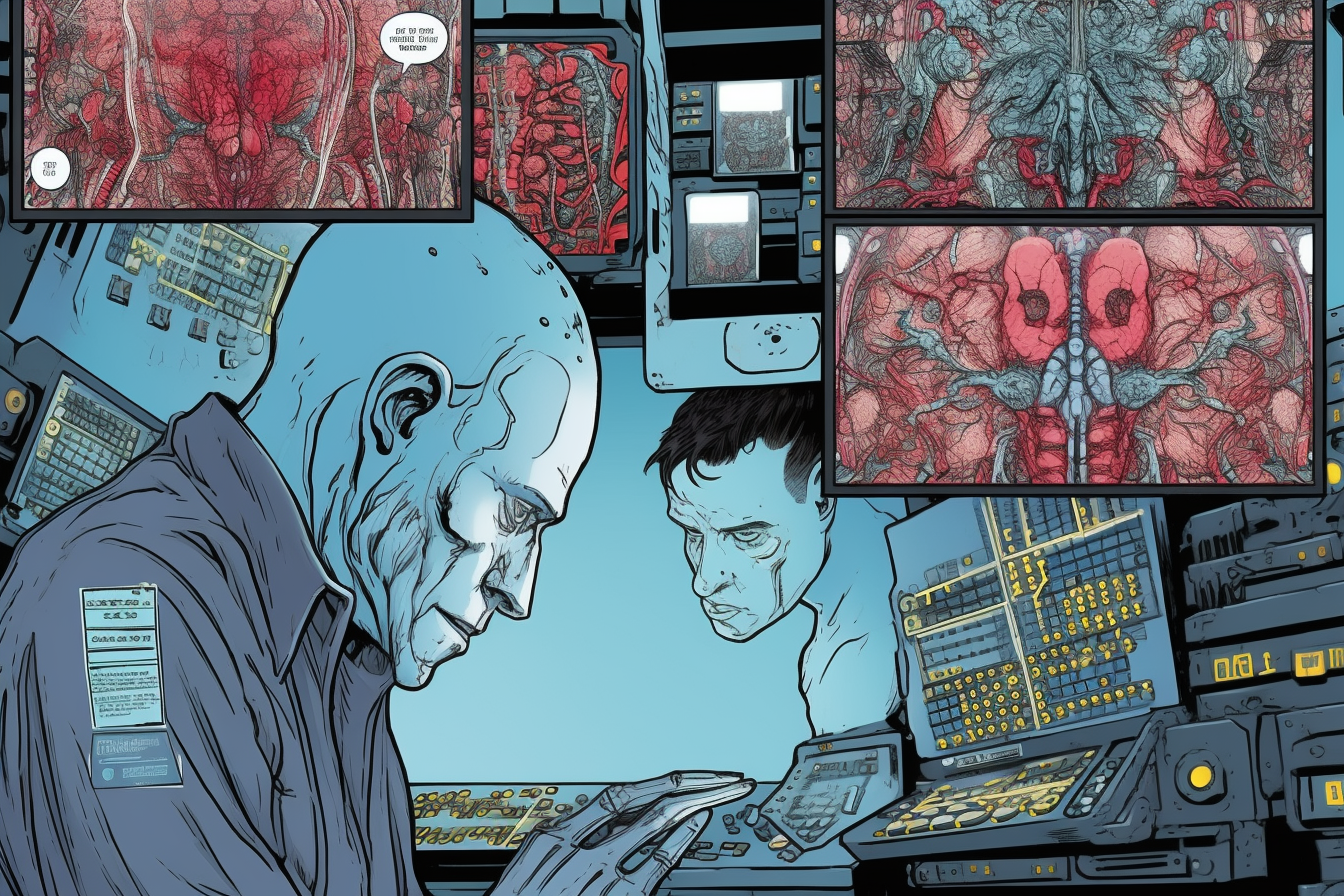
<a data-fancybox="gallery" data-selectable="true" data-caption="comic book panels showing artificial intelligence developing antibiotics for humans --v 5 --ar 15:10 --q 0.5" href="/images/stock-mj-ai-antibiotics.png"><img src="/images/stock-mj-ai-antibiotics.png" alt="comic book panels showing artificial intelligence developing antibiotics for humans --v 5 --ar 15:10 --q 0.5" width="" height="" align="" /></a>
<figcaption>comic book panels showing artificial intelligence developing antibiotics for humans --v 5 --ar 15:10 --q 0.5</figcaption>
</figure>

<h2 id="applying-this-to-the-coffee-industry">Applying this to the coffee industry</h2>

<p>Novel ideas and new ways of thinking about problems are the golden eggs of AI so far. Having AI to perform tedious, mind-numbing work is good. Yes, it will make a lot of paid-jobs obsolete and that will impact a lot of marginalized and impoverished workers. We’ll need to make sure we do our best to bring them along rather than leave them behind.</p>

<p>AI, or the algorithms and learning models we’re currently calling AI are already disruptive to some creative portions of the coffee industry; namely marketing departments. You can, today, use a language learning model (such as ChatGPT) and a text-to-image model (such as Midjourney) to create entire marketing campaigns. You can use a language model to generate a Twitter thread. You can use Midjourney + ChatGPT to generate an Instagram post. You can design package labels, logos, icons, etc with the tools currently available.</p>

<p>Entire paragraphs in this article were written by AI. Can you guess which ones?</p>

<p>AI is already disrupting the industry. We just need to make sure we collectively benefit from the disruption.</p>

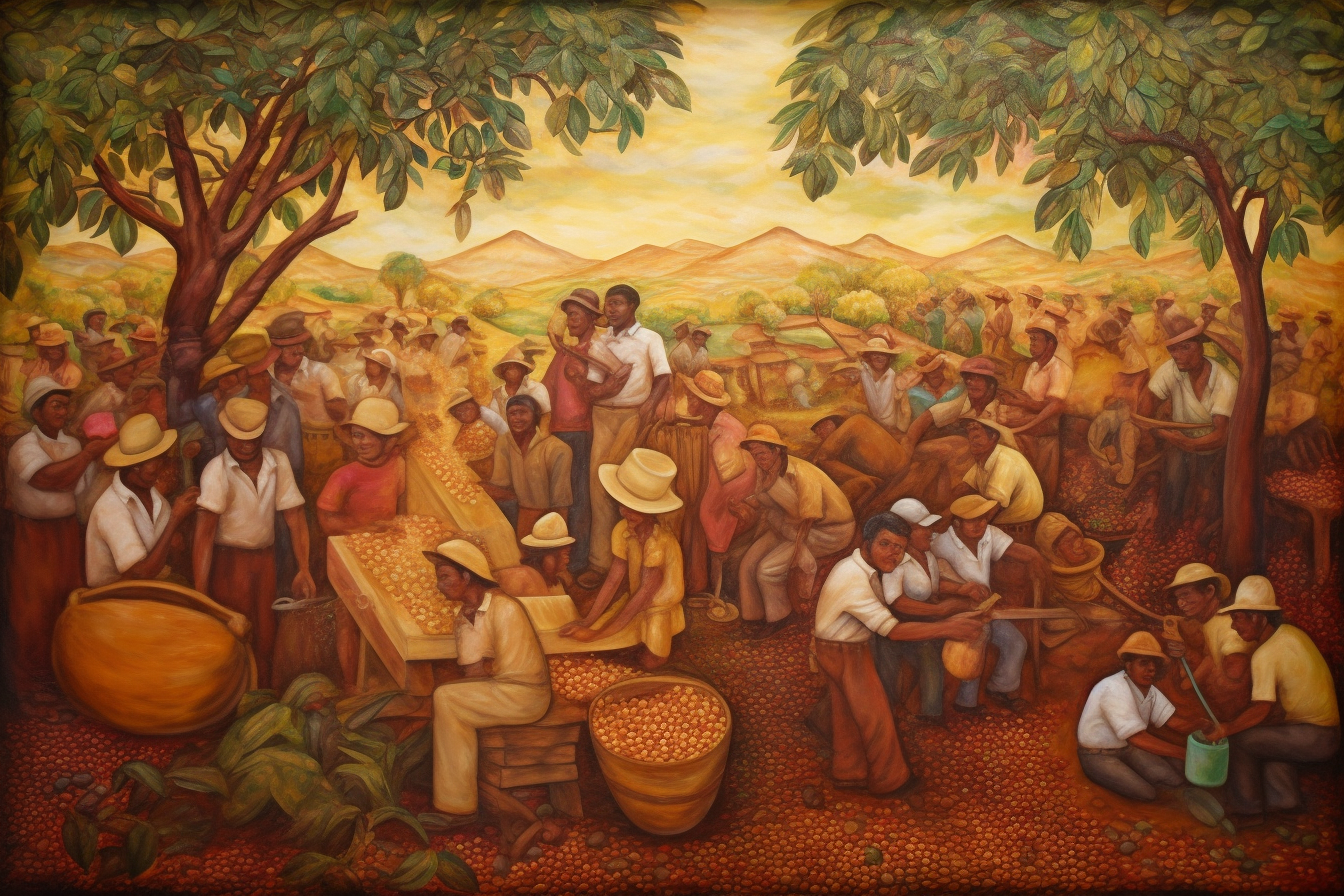
<p>The following image was generated by Midjourney, using a prompt generated by ChatGPT. Both outputs are impressive.</p>

<p>My prompt to ChatGPT was:</p>

<p><em>In a short paragraph or less provide a detailed description of an oil painting that depicts the entire coffee value chain, from seed to cup, in one single image. Use long-tail descriptions, lots of adjectives, choose a medium type, and name an artist who might paint such a picture. The description will be used to generate a compelling image using an AI text-to-image synthesis system.</em></p>

<p>ChatGPT’s response:</p>

<blockquote>The oil painting that depicts the entire coffee supply chain is a vibrant and dynamic work of art. The painting showcases the journey of coffee beans from their origin to the moment they are served in a cup. In the center of the painting, a tall and majestic coffee tree is depicted, surrounded by colorful workers picking and sorting the ripe coffee cherries. Moving along, the beans are processed and dried, with workers carefully monitoring the quality of the beans. Next, the painting shows the beans being roasted in a traditional roaster, filling the air with a rich aroma. Finally, the painting shows a barista expertly brewing a cup of coffee and presenting it to a happy customer. The use of light and shadow in the painting highlights the beauty of the different stages of the coffee supply chain. An artist who might create such a painting is David Hockney, a British painter known for his vibrant use of color and dynamic compositions.</blockquote>

<p>Midjourney’s response using ChatGPT’s prompt:</p>

<figure>
<a data-fancybox="gallery" data-selectable="true" data-caption="The Coffee Supply Chain as envissioned by Midjourney" href="/images/stock-mj-coffee-supply-chain.png"><img src="/images/stock-mj-coffee-supply-chain.png" alt="The Coffee Supply Chain as envissioned by Midjourney" width="" height="" align="" /></a> 
</figure>
<div class="footnotes" role="doc-endnotes">
  <ol>
    <li id="fn:4">
      <p><a href="https://www.deepmind.com/blog/deepmind-ai-reduces-google-data-centre-cooling-bill-by-40" rel="noopener noreferrer external">https://www.deepmind.com/blog/deepmind-ai-reduces-google-data-centre-cooling-bill-by-40</a> <a href="#fnref:4" class="reversefootnote" role="doc-backlink">&#8617;</a></p>
    </li>
    <li id="fn:1">
      <p><a href="https://www.nytimes.com/2018/12/26/science/chess-artificial-intelligence.html" rel="noopener noreferrer external">https://www.nytimes.com/2018/12/26/science/chess-artificial-intelligence.html</a> <a href="#fnref:1" class="reversefootnote" role="doc-backlink">&#8617;</a></p>
    </li>
    <li id="fn:2">
      <p><a href="https://www.amazon.com/Age-AI-Our-Human-Future-ebook/dp/B095XH2N6Q" rel="noopener noreferrer external">Amazon.com: The Age of AI: And Our Human Future, Kindle Edition</a> <a href="#fnref:2" class="reversefootnote" role="doc-backlink">&#8617;</a></p>
    </li>
    <li id="fn:3">
      <p><a href="https://news.mit.edu/2020/artificial-intelligence-identifies-new-antibiotic-0220" rel="noopener noreferrer external">https://news.mit.edu/2020/artificial-intelligence-identifies-new-antibiotic-0220</a> <a href="#fnref:3" class="reversefootnote" role="doc-backlink">&#8617;</a></p>
    </li>
  </ol>
</div>]]></content><author><name>Michael C. Wright</name><email>MichaelTrains@OilSlickCoffee.com</email></author><category term="Economics" /><category term="Smallholders" /><category term="ChatGPT" /><category term="Midjourney" /><category term="Coffee Production" /><category term="Sustainable coffee production" /><category term="Sustainable development" /><summary type="html"><![CDATA[AI (or the algorithms and learning models we’re currently calling AI) will be disruptive. We just need to make sure we collectively benefit from the disruption.]]></summary><media:thumbnail xmlns:media="http://search.yahoo.com/mrss/" url="https://oilslickcoffee.com/%7B%22feature%22%20=%3E%20nil,%20%22teaser%22%20=%3E%20%22stock-mj-coffee-supply-chain-th.png%22,%20%22thumb%22%20=%3E%20nil%7D" /><media:content medium="image" url="https://oilslickcoffee.com/%7B%22feature%22%20=%3E%20nil,%20%22teaser%22%20=%3E%20%22stock-mj-coffee-supply-chain-th.png%22,%20%22thumb%22%20=%3E%20nil%7D" xmlns:media="http://search.yahoo.com/mrss/" /></entry><entry><title type="html">Making Better Coffee by Edward F. Fischer</title><link href="https://oilslickcoffee.com/making-better-coffee-by-edward-f-fischer/" rel="alternate" type="text/html" title="Making Better Coffee by Edward F. Fischer" /><published>2023-03-20T09:33:00+00:00</published><updated>2023-03-20T09:33:00+00:00</updated><id>https://oilslickcoffee.com/making-better-coffee-by-edward-f-fischer</id><content type="html" xml:base="https://oilslickcoffee.com/making-better-coffee-by-edward-f-fischer/"><![CDATA[<p>I was first introduced to Edward (Ted) Fischer’s ideas about Third Wave Coffee through his paper titled “Quality and inequality: creating value worlds with Third Wave coffee.” The book brings forward and further develops several of the ideas and research documented in that paper. I enjoyed the paper and wrote an article in response to it, titled <a href="/economics/market/in-defense-of-tastemakers/">In Defense of Tastemakers</a></p>

<p><strong>See also: <a href="/economics/market/in-defense-of-tastemakers/?utm_source=Making-Better-Coffee-by-Edward-F.-Fischer&amp;utm_medium=blog&amp;utm_content=/economics/market/in-defense-of-tastemakers/&amp;utm_campaign=see-also">In Defense of Tastemakers</a></strong></p>

<p><em>Making Better Coffee</em> has six chapters plus a conclusion:</p>

<ol>
  <li>Creating Third Wave Values</li>
  <li>Plant Biology, Capitalist Trade, and the Colonial Histories of Coffea arabica</li>
  <li>German Oligarchs, First Wave Coffee, and Guatemala’s Enduring Structures of Inequality</li>
  <li>Austrian Economics and the Quality Turn in Guatemala Coffee</li>
  <li>Maya Farmers and Second Wave Coffee</li>
  <li>Cooperation, Competition, and Cultural Capital in Third Wave Markets</li>
</ol>

<p>Fischer intends for <em>Making Better Coffee</em> to be a study of the interplay of material and symbolic values. These values are also at the core of the SCA’s new Coffee Value Assessment System. In 2019, Fischer spoke at the Re:co symposium and will return as a speaker <a href="https://www.recosymposium.org/" rel="noopener noreferrer external">this year</a>. This review will primarily focus on the book’s exploration of value and values, due to the relationship between the SCA’s value system and Fischer’s work in the book.</p>

<p>I think that most people who read this blog and follow the SCA will be interested in that connection, especially with the SCA rolling out it’s new system. But readers should know that the book provides much deeper and broader information and has value beyond just understanding the SCA’s value system in relation to Fischer’s research and ideas. He provides an anthropoligist’s view of the history of coffee production in Guatemala, doing so with a level of detail that requires five chapters. <em>Making Better Coffee</em> is as much a history book as it is a presentation of his study of what value is in the coffee supply chain, who gets to define that value, and what are the ramifications of that power dynamic.</p>

<iframe width="560" height="315" src="https://www.youtube.com/embed/q__uutCRpDw" title="YouTube video player" frameborder="0" allow="accelerometer; autoplay; clipboard-write; encrypted-media; gyroscope; picture-in-picture; web-share" allowfullscreen=""></iframe>

<p>In the first chapter, Fischer lays out the foundation for the rest of the book: the material and symbolic means of production:</p>

<blockquote><p>The rarefied price of high-end coffee is justified through the artful translation of qualities and connotations across symbolic and material value worlds. This is to say that the values of terroir and authenticity are created not just by the material conditions of the farms but also by the narratives of roasters, baristas, and tastemakers. It is the interplay of material use values and more effective and symbolic values—and how these come together in the meaningful and sensual act of consuming a craft coffee—that justify Third Wave prices.</p><cite><a class="citation" href="#fischer_making_2022">(Fischer, 2022)</a></cite></blockquote>

<p>Fischer is talking about something more than just marketing, though at its core, that’s what it is. The focus of the book is largely on the consequences of that interplay between material and symbolic values that produces successful marketing and what that success means for smallholder producers, such as Maya farmers in Guatemala.</p>

<p>The structural disadvantages imposed upon smallholder farmers are the consequences he talks about. Chapter 6 discusses what this might look like:</p>

<blockquote><p>[D]espite growing coffees that score highly on the hundred-point SCA scale, most Maya farmers lack the social and cultural captial to access the more symbolic and narratively driven high-end markets. Further, farmers' need and desire for cooperative forms of organizing, which aggregate the harvests from many small farmers, do not mesh with Third Wave preferences for "single-estate" lots tied to the biographies of individual growers. Finally, as the Third Wave market matures, there has been a growing focus on roasting techniques and brewing technologies, adding more value at the consumer end of the circuit.</p><cite><a class="citation" href="#fischer_making_2022">(Fischer, 2022)</a></cite></blockquote>

<p>This is the crux of the problem as identified by Fischer; the shift towards greater valuation of intangible, nonmaterial, symbolic assets and objects, away from the material means of production. The shift toward greater valuation of intangible, nonmaterial, symbolic assets and objects means that more power is being shifted from the supply side of the value chain toward the demand side. As coffee moves through the value chain and is transformed into a consumable product, value is added both mechanistically and romantically.</p>

<center><em>raw material → intermediate product → consumable product</em></center>

<center>or</center>

<center><em>farm → mill → roastery</em></center>

<p>Fischer argues that the Third Wave market is at a point where the generation of romantic or symbolic value is instrumental in disproportionately more wealth being generated from coffee in importing countries than in exporting countries.</p>

<p>Thinking about this has had a strong influence on my development of a concept I call the <em>central dogma of coffee</em>. The central dogma explains the one-way transition of seed to coffee bean and how that transition impacts the value of the coffee.</p>

<p><strong>See also: <a href="/market/the-central-dogma-of-coffee/?utm_source=Making-Better-Coffee-by-Edward-F.-Fischer&amp;utm_medium=blog&amp;utm_content=/market/the-central-dogma-of-coffee/&amp;utm_campaign=see-also">The Central Dogma of Coffee</a></strong></p>

<p>In the final paragraph of his book, Fischer writes:</p>

<blockquote><p>What we need is a post-Enlightenment approach to political economy that recognizes the interrelatedness of domains of life and the qualitatively different value worlds in which they are enmeshed. Toward that end, we might return to humanistic, narrative approaches to decision making that address policitcal and moral issues as such, and not just as technical problems of humans failing to conform to rational expectations.</p><cite><a class="citation" href="#fischer_making_2022">(Fischer, 2022)</a></cite></blockquote>

<p>What tastemakers can do with an understanding of Fischer’s ideas and the results of his research is a question I hope to be able to pose to Fischer in a future interview. 🤞</p>

<p>Update: I was able to sit down with Ted at Re:co Symposium 2023 and talk about his experience there at Symposium as well as his book and his work in Guatemala:</p>

<iframe width="560" height="315" src="https://www.youtube.com/embed/vEP7HPnanUI" title="YouTube video player" frameborder="0" allow="accelerometer; autoplay; clipboard-write; encrypted-media; gyroscope; picture-in-picture; web-share" allowfullscreen=""></iframe>

<p>The interview is also available as a podcast episode that is transcribed. You can listen to it on the episode’s home page: <a href="/audio/interview-fischer/?utm_source=Making-Better-Coffee-by-Edward-F.-Fischer&amp;utm_medium=blog&amp;utm_content=/audio/interview-fischer/&amp;utm_campaign=see-also">[S4:E9] Interview with Edward (Ted) Fischer</a>.</p>

<p>Edward Fischer is a professor of anthropology at Vanderbilt University in Tennessee. He directs Vanderbilt’s <a href="https://www.vanderbilt.edu/ics/" rel="noopener noreferrer external">Institute for Coffee Studies</a>. Other books he’s written include <em>The Good Life: Aspiration, Dignity, and the Anthropology of Wellbeing</em>. Fischer has also published a number of <a href="https://scholar.google.com/citations?user=5Aq_vCsAAAAJ" rel="noopener noreferrer external">scholarly articles and research papers</a>.</p>

<ol class="bibliography"><li><span id="fischer_making_2022">Fischer, E. F. (2022). <i>Making better coffee: how Maya farmers and Third Wave tastemakers create value</i>. University of California Press.</span></li></ol>]]></content><author><name></name></author><category term="Coffee Books" /><category term="Book Review" /><category term="Coffee Production" /><category term="Guatemala" /><category term="Smallholders" /><category term="Third Wave Coffee" /><category term="Making Better Coffee" /><category term="Edward F. Fischer" /><summary type="html"><![CDATA[Edward Fischer's book "Making Better Coffee" explores the interplay of material and symbolic values in the coffee supply chain and their consequences.]]></summary><media:thumbnail xmlns:media="http://search.yahoo.com/mrss/" url="https://oilslickcoffee.com/%7B%22feature%22%20=%3E%20nil,%20%22teaser%22%20=%3E%20%22making-better-coffee-th.jpeg%22,%20%22thumb%22%20=%3E%20nil%7D" /><media:content medium="image" url="https://oilslickcoffee.com/%7B%22feature%22%20=%3E%20nil,%20%22teaser%22%20=%3E%20%22making-better-coffee-th.jpeg%22,%20%22thumb%22%20=%3E%20nil%7D" xmlns:media="http://search.yahoo.com/mrss/" /></entry><entry><title type="html">Climate-smart production of coffee, edited by Professor Reinhold Muschler</title><link href="https://oilslickcoffee.com/climate-smart-production-of-coffee/" rel="alternate" type="text/html" title="Climate-smart production of coffee, edited by Professor Reinhold Muschler" /><published>2023-02-02T08:05:00+00:00</published><updated>2023-02-02T08:05:00+00:00</updated><id>https://oilslickcoffee.com/climate-smart-production-of-coffee</id><content type="html" xml:base="https://oilslickcoffee.com/climate-smart-production-of-coffee/"><![CDATA[<p>The subtitle is “Improving social and environmental sustainability,” which indicates to readers the goal of the book; to illustrate <em>how</em> producers can improve in those domains.</p>

<p>The book is organized into two parts containing a total of fourteen chapters. Each chapter is further broken down into sections and the chapters are written to stand alone. Most of the chapters are written by different authors. Nearly every chapter contains a section titled “Where to look for further information” and most also have a references section. There are color photos and illustrations throughout the book.</p>

<h2 id="part-1">Part 1</h2>

<p>Part 1 is titled “Improving social and environmental sustainability” and first describes global coffee production as it currently is with chapters titled “Global coffee production and sustainability” and “The coffee sector and smallholder farmers.” Chapter 3 provides details on “Assessing and managing the environmental and social impact of coffee production” by explaining a few ways to measure and quantify sustainability. The final four chapters of Part 1 explain a few possible ways of improving social and environmental sustainability (or at least ways of thinking about it) through “Specialty coffees as drivers of change,” “Fair-trade coffee: how fair is fair?,” “Advances in Arabica coffee breeding: developing and selecting the right varieties,” and “Optimizing post-harvest practices in coffee cultivation.”</p>

<p>Note that chapter 1, “Global coffee production and sustainability” is available as a separate, ebook for purchasing <a href="https://shop.bdspublishing.com/store/bds/detail/product/3-190-9781801465878" rel="noopener noreferrer external">online</a>. I wrote a <a href="/reviews/global-coffee-production-and-sustainability-by-carlos-h-j-brando/">separate review</a> of that ebook.</p>

<p><strong>See also: <a href="/reviews/global-coffee-production-and-sustainability-by-carlos-h-j-brando/?utm_source=Climate-smart-production-of-coffee,-edited-by-Professor-Reinhold-Muschler&amp;utm_medium=blog&amp;utm_content=/reviews/global-coffee-production-and-sustainability-by-carlos-h-j-brando/&amp;utm_campaign=see-also">Global coffee production and sustainability by Carlos H. J. Brando</a></strong></p>

<h2 id="part-2">Part 2</h2>

<p>Part 2, “Sustainable pest and disease management” dives into the nitty-gritty of one of the key issues regarding sustainable production: pest and disease management. Multiple chapters in this section talk about integrated pest management (IPM), which is the deployment of a combination of practices to address pests and plant diseases using “current, comprehensive information on the life cycles of pests and their interaction with the environment.” <a class="citation" href="#epa_ipm">(US EPA, OCSPP, 2015)</a> The goal being the control of pests and diseases in a way that is both effective and sensitive to the environment.</p>

<p>For example, the last three chapters of the book, chapters 12-14 all deal with integrated management:</p>

<p>Chapter 12: Integrated management of nematodes of coffee: Regina M. D. G. Carneiro and Marcilene F. A. dos Santos, Embrapa Recursos Genética e Biotecnologia, Brazil;</p>

<p>Chapter 13: Integrated management of soil-borne insect and fungal pests of coffee : Cesar J. Fanton and Renan B. Queiroz, Instituto Capixaba de Pesquisa, Assistência Técnica e Extensão Rural (INCAPER), Brazil; and Laércio Zambolim, Universidade Federal de Viçosa, Brazil;</p>

<p>Chapter 14: Integrated weed management in coffee production: Cláudio Pagotto Ronchi, Federal University of Viçosa, Brazil;</p>

<h2 id="integrated-management">Integrated management</h2>

<p>Integrated management is an important concept for sustainable agriculture because it takes a systemic approach — it addresses pests and/or diseases from several different aspects of their lifecycle in a way that takes into consideration the complexity of an ecosystem.</p>

<p>For example, chapter 11, “Coffee wilt disease” by Julie Flood first documents the history and impact of the disease, its host range, symptoms, and ecology, then it describes the historical management process of the disease, which amounted to sanitation and screening/breeding for resistance. When farmers encountered infected plants, the recommendation was to uproot and burn the material. Prevention techniques boiled down to farmers planting pre-screened breeds verified to have resistance to the fungus that causes the disease. This process proved successful and the disease was classified as a “minor disease, of little importance to arabica and robusta coffee production.”</p>

<p>However, in the 70’s and 80’s the disease began to re-emerge from abandoned plots and the standard approach of ‘uprooting and long term breeding programs’ was proving too slow to contain the spread of the disease. An integrated management program called the Regional Coffee Wilt Programme (RCWP) was developed, as recommended by Dr. Flood—a scientist <a href="https://www.bspp.org.uk/julie-flood-is-one-of-our-40-faces-of-plant-pathology/" rel="noopener noreferrer external">you should know</a>. The RCWP began with several studies and surveys, such as biological surveys in country, socio-economic surveys in country, studies of the pathogen, of host variation and screening for resistance, of transmission pathways and management, of environmental influence on infection, and also studies of agronomic treatments of coffee wilt disease.</p>

<p>The resulting recommendations are illustrative of <em>integrated management</em>:</p>

<ul>
  <li>Regular monitoring to detect infections early</li>
  <li>Regular cleaning of tools to reduce the spread</li>
  <li>Minimizing tree wounds while slashing weeds</li>
  <li>Uprooting and burning infected trees and leaving a fallow period of at least 3 months</li>
  <li>Discourage the use of using infected wood as firewood</li>
  <li>Regional and national distribution of pre-screened, resistant plant material</li>
  <li>Improved preparedness for disease epidemics among government and non-government organizations</li>
  <li>Breeding for resistance remained the ideal strategy</li>
</ul>

<p>Note that Chapter 11, “Coffee wilt disease” is an open-access chapter distributed under the Creative Commons Attribution 4.0 License (CC BY) and is available to download <a href="https://www.bdschapters.com/webshop/open-access/coffee-wilt-disease/" rel="noopener noreferrer external">here</a>.</p>

<p>I am using chapter 11 as an example of what I hoped the book would provide; actionable intelligence that can be used by extension agents for example, when supporting smallholder farmers. <em>Climate-smart production</em> largely achieves that. Most chapters have a subsection dedicated to recommending a course of action, such as “weed control methods” (chpt. 14),  or “natural enemies for key insect pests in coffee agroecosystems” (chpt. 8).</p>

<p>The one notable exception might be chapter 10, “Ecological perspectives on the coffee leaf rust.” Rather than providing direct recommendations for ‘improving social and environmental sustainability,’ this chapter highlights an area of research the authors Zachary Hajian-Forooshani and John Vandermeer feel needs more attention. The authors state the following towards the end of the chapter:</p>

<blockquote><p>The scope of this chapter has been made intentionally narrow to focus on what the authors consider to be potentially fruitful areas of research that they hope to bring attention to the larger community of coffee researchers as well as other agroecologists.</p><cite><a class="citation" href="#Muschler_2022">(<i>Climate-Smart Production of Coffee: Improving Social and Environmental Sustainability</i>, 2022, p. 313)</a></cite></blockquote>

<p>Their goal with the chapter is to “refocus an ecological approach to the problem of CLR” by discussing “the community ecology and natural enemies of CLR around the world.” For me, this made for a very interesting and new take on thinking about how to control CLR. They present two case studies of ecological complexity and the coffee leaf rust:</p>

<ul>
  <li>The regionally distinct ecological communities of Puerto Rico and Mexico</li>
  <li>Theoretical perspectives on space and environmental forces</li>
</ul>

<p>In keeping with <em>integrated management</em>, their focus takes a <em>complex systems</em> approach, considering as much of the ecology surrounding the pathogen as possible, rather than a myopic or narrowly focused approach of ‘my coffee trees have CLR, now how do I get rid of it?’</p>

<h2 id="conclusion">Conclusion</h2>

<p>This book would make a fine addition to the library of any serious coffee extension agent, Q Processor Pro, and even conscientious green coffee buyers. It illustrates how to think about improving the social and environmental sustainability of coffee production; by thinking of and treating coffee production as a complex system of interrelated, interdependent parts.</p>

<h2 id="references">References</h2>

<ol class="bibliography"><li><span id="epa_ipm">US EPA, OCSPP. (2015). <i>Integrated Pest Management (IPM) Principles</i>. https://www.epa.gov/safepestcontrol/integrated-pest-management-ipm-principles</span></li>
<li><span id="Muschler_2022"><i>Climate-smart production of coffee: improving social and environmental sustainability</i>. (2022). Burleigh Dodds Science Publishing.</span></li></ol>]]></content><author><name></name></author><category term="Sustainability" /><category term="Coffee Books" /><category term="Book Review" /><category term="Coffee Production" /><category term="Sustainable coffee production" /><category term="Smallholders" /><summary type="html"><![CDATA[Climate-smart production does a good job of describing coffee production as it currently is and provides several ways of improving social and environmental sustainability.]]></summary><media:thumbnail xmlns:media="http://search.yahoo.com/mrss/" url="https://oilslickcoffee.com/%7B%22feature%22%20=%3E%20nil,%20%22teaser%22%20=%3E%20%22climate-smart-th.jpeg%22,%20%22thumb%22%20=%3E%20nil%7D" /><media:content medium="image" url="https://oilslickcoffee.com/%7B%22feature%22%20=%3E%20nil,%20%22teaser%22%20=%3E%20%22climate-smart-th.jpeg%22,%20%22thumb%22%20=%3E%20nil%7D" xmlns:media="http://search.yahoo.com/mrss/" /></entry><entry><title type="html">Global coffee production and sustainability by Carlos H. J. Brando</title><link href="https://oilslickcoffee.com/reviews/global-coffee-production-and-sustainability-by-carlos-h-j-brando/" rel="alternate" type="text/html" title="Global coffee production and sustainability by Carlos H. J. Brando" /><published>2023-01-10T08:18:00+00:00</published><updated>2023-01-10T08:18:00+00:00</updated><id>https://oilslickcoffee.com/reviews/global-coffee-production-and-sustainability-by-carlos-h--j--brando</id><content type="html" xml:base="https://oilslickcoffee.com/reviews/global-coffee-production-and-sustainability-by-carlos-h-j-brando/"><![CDATA[<p>This ebook is the first chapter of a larger book titled <i><a href="https://amzn.to/3CC2PjU" rel="noopener noreferrer external">Climate-smart production of coffee: Improving social and environmental sustainability</a></i>, which I am currently reading and plan to write a review of as well.</p>

<p>The chapter is <a href="https://shop.bdspublishing.com/store/bds/detail/product/3-190-9781801465878" rel="noopener noreferrer external">available on its own from the publisher Burleigh Dodds</a> and it would certainly be good for any coffee professional as a means of gaining a broader, 40,000-foot view of the global coffee market, regardless of where in the supply chain one works.</p>

<p>There are nine sections in <i>Global coffee production</i>, plus links for further reading and the references cited:</p>

<ol>
  <li>Introduction</li>
  <li>Coffee farmer incomes and sustainability</li>
  <li>Concentration and diversity in global coffee production</li>
  <li>Specialty and differentiated coffees</li>
  <li>Trends in Arabica and Robusta coffees</li>
  <li>Creating an enabling environment to make coffee farming more sustainable</li>
  <li>The case of Brazil in improving coffee grower incomes</li>
  <li>Farm size, income and sustainability</li>
  <li>Conclusion</li>
  <li>Where to look for further information</li>
  <li>References</li>
</ol>

<p><i>Global coffee production</i> provides good insights into the broader market, as well as specific concerns regarding smallholder producers. It briefly discusses several different wasy to increase profitability, to include value-added products and differentiated coffees i.e., specialty coffee, local consumption, plot rejuvenation with regenerative agricultural techniques, increased productivity (quantity over quality), and more.</p>

<p>Regular readers of mine will know I’m a big fan of programs to develop local consumption and I was happy to see that this chapter spends some time exploring how Brazil has helped improve grower incomes by focusing in part on local consumption.</p>

<p><strong>See also: <a href="/economics/market/local-consumption-wins-in-brazil-and-colombia/?utm_source=Global-coffee-production-and-sustainability-by-Carlos-H.-J.-Brando&amp;utm_medium=blog&amp;utm_content=/economics/market/local-consumption-wins-in-brazil-and-colombia/&amp;utm_campaign=see-also">Local Consumption Wins in Brazil and Colombia</a></strong></p>

<p>One of the concepts I find particularly interesting and useful in thinking about the challenge of sustainable coffee production is the concept of the enabling environment. The enabling environment is the sum-total of efforts by both the government and private sectors, such as governmental policies, improved infrastructure, market research and development, good agricultural practices (GAP), etc. It could be called the greater terroir of sustainable coffee production. Section six of the chapter dives into the enabling environment, after previous sections give an overview of the existing global market. Then section seven explains some of the specifics of an enabling environment in Brazil. Some of the interventions listed include: <a class="citation" href="#inbook_global_coffee_production_2022">(Brando &amp; P&amp;A Marketing, Brazil, 2022)</a></p>

<ul>
  <li>Individual universities, research institutes and foundations became much more active in coffee research</li>
  <li>The creation of the Coffee Research Consortium that provided focus and strategic planning programs for coffee research</li>
  <li>Extension and training services performed by the IBC were progressively transferred to state governments and farmer cooperatives</li>
  <li>New varieties, greater planting densities, mechanization and GAP were introduced to significantly improve productivity</li>
  <li>The pulped natural system (also called the CD or honey system) was developed and on-farm processing increased.</li>
  <li>Streamlining the supply chain from farm gate to harbor</li>
  <li>Rebranding Brazilian coffees from a standard fair commercial quality to a range of quality standards, including specialty coffees.</li>
  <li>Developing laws requiring banks to channel a given percentage of deposits to low interest financing of agricultural activities.</li>
  <li>Exemptions from sales taxes for agriproducts that are exported.</li>
</ul>

<p>The broadness of the above interventions helps illustrate what an enabling environment might look like.</p>

<p>This ebook is a great asset if you want a deeper understanding of the global coffee market and are looking for a foundation on which to understand ways to sustainably produce coffee.</p>

<ol class="bibliography"><li><span id="inbook_global_coffee_production_2022">Brando, C. H. J., &amp; P&amp;A Marketing, Brazil. (2022). Global coffee production and sustainability. In R. Muschler (Ed.), <i>Climate-smart production of coffee</i> (pp. 3–20). Burleigh Dodds Science Publishing Limited. https://shop.bdspublishing.com/store/bds/detail/product/3-190-9781801465878</span></li></ol>]]></content><author><name></name></author><category term="Reviews" /><category term="Coffee Books" /><category term="Book Review" /><category term="Enabling environment" /><category term="Sustainable coffee production" /><category term="Sustainable development" /><summary type="html"><![CDATA[This book is a great asset if you want a deeper understanding of the global coffee market and are looking for a foundation on which to understand ways to sustainably produce coffee.]]></summary><media:thumbnail xmlns:media="http://search.yahoo.com/mrss/" url="https://oilslickcoffee.com/%7B%22feature%22%20=%3E%20nil,%20%22teaser%22%20=%3E%20%22global-coffee-production-cover-th.jpeg%22,%20%22thumb%22%20=%3E%20nil%7D" /><media:content medium="image" url="https://oilslickcoffee.com/%7B%22feature%22%20=%3E%20nil,%20%22teaser%22%20=%3E%20%22global-coffee-production-cover-th.jpeg%22,%20%22thumb%22%20=%3E%20nil%7D" xmlns:media="http://search.yahoo.com/mrss/" /></entry><entry><title type="html">Coffee Roasting: Best Practices by Scott Rao</title><link href="https://oilslickcoffee.com/reviews/coffee-roasting/" rel="alternate" type="text/html" title="Coffee Roasting: Best Practices by Scott Rao" /><published>2022-09-19T11:51:00+00:00</published><updated>2022-09-19T11:51:00+00:00</updated><id>https://oilslickcoffee.com/reviews/coffee-roasting</id><content type="html" xml:base="https://oilslickcoffee.com/reviews/coffee-roasting/"><![CDATA[<p>Coffee Roasting: Best Practices makes a great follow-up to the author’s previous book The Coffee Roaster’s Companion. The <em>Companion</em> introduced operators to now-popular concepts such as the flick and crash and the idea that operators should pay very close attention to the rate of change. <em>Roaster’s companion</em> also discussed other imporant topics such as between-batch protocols, a concept expanded in <em>Roasting</em>.</p>

<p>In my review of <em>Companion</em>, I commented that it lacked many “tactical” solutions for roaster operators and I am happy to report that Rao provides plenty in the follow-on book <em>Coffee Roasting</em>.</p>

<p><strong>See also: <a href="/reviews/the-coffee-roasters-companion-by-scott-rao/?utm_source=Coffee-Roasting:-Best-Practices-by-Scott-Rao&amp;utm_medium=blog&amp;utm_content=/reviews/the-coffee-roasters-companion-by-scott-rao/&amp;utm_campaign=see-also">The Coffee Roasters Companion By Scott Rao</a></strong></p>

<p>Coffee Roasting: Best Practices has nineteen chapters spanning ninety pages, making it a quick and easy cover-to-cover read. But it’s chock-full of details and specific content that will allow for on-going reading and re-reading.</p>

<p>In the preface, Rao mentions that he was unsure how the content in <em>Companion</em> would be received and I know from my experience, the content was very well received. I personally have spent a lot of time focusing on his concepts and I have interacted with a lot of people through my content, who are interested as well. So if I had a direct line to Rao, I’d say ‘Great stuff! And keep it up!’ I consider Rao’s books essential library material for the curious and serious roaster alike.</p>

<p>One of the topics I especially enjoyed in <em>Roasting</em> is the chapter titled “Tuning Your Roaster.” In that chapter, Rao recommends ways to ensure your gas roaster is properly fueled, as well as expanding on the topic of telemetry that was also discussed in <em>Companion</em>. Temp probes have their own chapter, titled “How Probe Speed and Location Influence Curves.” He makes a very good point that the type and placement of your probe determines its performance and usefulness. He also makes a point of emphasizing that the bean temp probe is more of a proxy reading of the outside of the beans and not necessarily indicative of their internal temp. I think it’s good to point out that we don’t have precise understanding of the environment <em>inside the bean</em> at any time.</p>

<p>Extending on the subject of telemetry and thermometry, there is a chapter titled “Roasting Software and Automation.” In that chapter he differentiates between general roasting software that can log useful data and commercial roastery management solutions (RMS). The operator’s experience with the software can indirectly impact the quality of their roasts and Rao has several recommendations on how to approach the choice of software to use.</p>

<p>At the end of the day, this is a wise addition to any roaster’s library of coffee books! I found the book approachable, easy to read, and something I can come back to later as a reference.</p>]]></content><author><name></name></author><category term="Reviews" /><category term="Scott Rao" /><category term="Flick And Crash" /><category term="Coffee Roasting" /><category term="Coffee Books" /><category term="Book Review" /><summary type="html"><![CDATA[Coffee Roasting: Best Practices has 19 chapters spanning 90 pages, making it a quick and easy read. But it’s also full of details and specifics that will allow for on-going reference.]]></summary><media:thumbnail xmlns:media="http://search.yahoo.com/mrss/" url="https://oilslickcoffee.com/%7B%22feature%22%20=%3E%20nil,%20%22teaser%22%20=%3E%20%22rao-coffee-roasting-th.jpeg%22,%20%22thumb%22%20=%3E%20nil%7D" /><media:content medium="image" url="https://oilslickcoffee.com/%7B%22feature%22%20=%3E%20nil,%20%22teaser%22%20=%3E%20%22rao-coffee-roasting-th.jpeg%22,%20%22thumb%22%20=%3E%20nil%7D" xmlns:media="http://search.yahoo.com/mrss/" /></entry></feed>